No products in the cart.

Exosomes vs Polynucleotides: Are We Regenerating Skin, Or Just Rebranding It?
If you’ve spent any time around aesthetic medicine over the last few years, you’ve probably noticed that one word has quietly taken over almost every conference, treatment brochure and social media advert.
Regenerative.
Regenerative skin treatments.
Regenerative aesthetics.
Regenerative medicine.
Regenerative injectables.
At some point, it became the industry’s favourite word.
The problem is that the more a word gets used, the less people stop to ask what it actually means.
Patients now search for exosomes treatment London and polynucleotides treatment London expecting to find two advanced treatments capable of rebuilding ageing skin from within. Depending on which website you read, they can apparently stimulate collagen, repair damaged tissue, reverse ageing, improve skin quality, accelerate healing and perhaps make your morning coffee taste better.
The claims often sound impressive.
The evidence is usually more complicated.
One of the things I’ve learnt over the years is that when everybody starts using the same buzzword, it’s usually worth becoming a little more sceptical.
Not cynical.
Sceptical.
There is a difference.
Cynicism dismisses everything.
Scepticism simply asks questions.
And regenerative medicine in aesthetics deserves some questions.
Not because exosomes are nonsense.
Not because polynucleotides are nonsense.
But because the conversation surrounding them often becomes detached from reality.
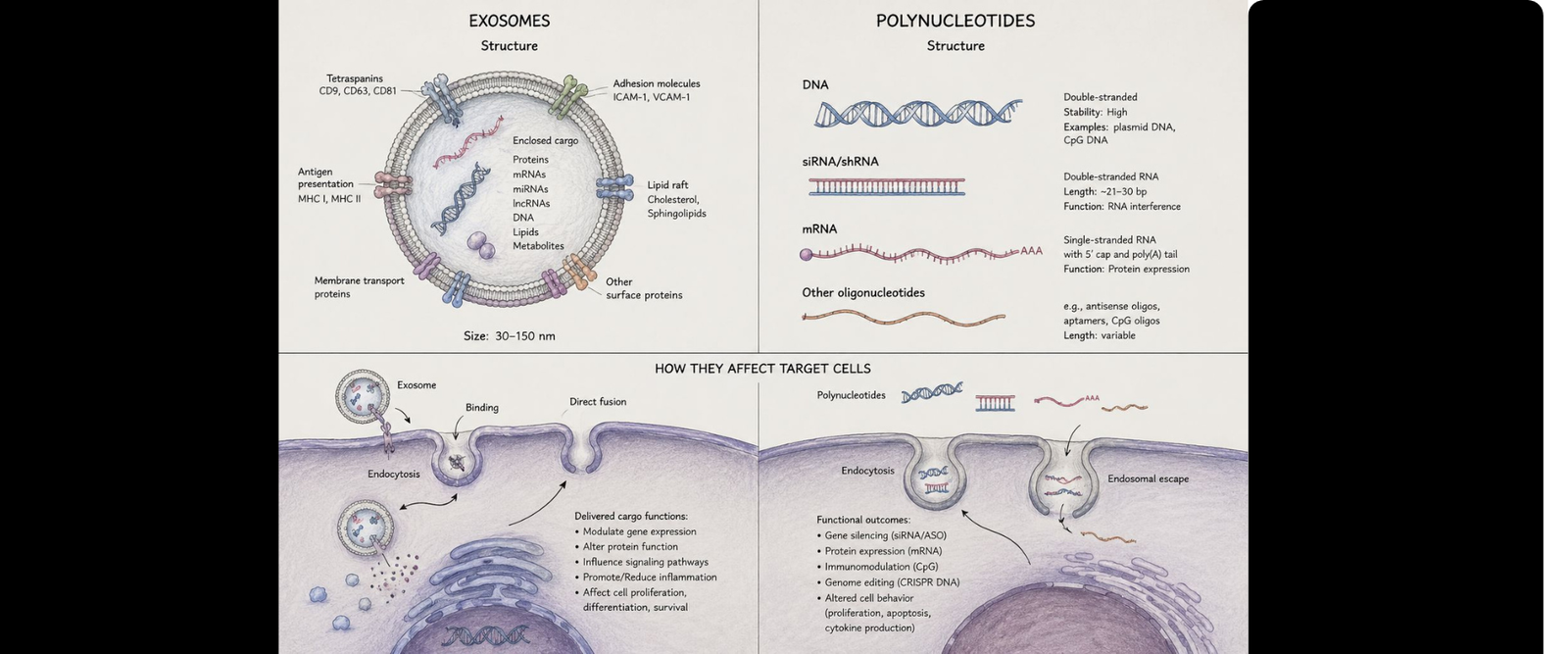
The first thing patients should know is that exosomes and polynucleotides are not remotely the same thing.
They’re often mentioned in the same sentence.
They’re often offered by the same clinics.
They’re often grouped under the same regenerative umbrella.
Yet their origins, their proposed mechanisms and the evidence supporting them are entirely different.
Comparing exosomes and polynucleotides is a little like comparing email and scaffolding.
Both may contribute to building something.
They’re performing completely different jobs.
The second thing patients should know is that neither treatment exists in a vacuum.
One of the biggest reasons people become disappointed with aesthetic treatments is because they start looking for the perfect product instead of the correct diagnosis.
A patient may spend weeks researching exosomes versus polynucleotides while completely overlooking the more important questions.
What is actually bothering them?
What are they hoping to improve?
Are they concerned about texture?
Pigmentation?
Redness?
Volume loss?
Laxity?
Fine lines?
Because those problems do not necessarily respond to the same treatment.
And this is where many clinics get themselves into trouble.
A syringe becomes the solution before the problem has been properly defined.
I’ve seen patients spend thousands chasing the newest regenerative treatment while ignoring the fundamentals.
Sun damage.
Inflammation.
Rosacea.
Poor skincare.
Volume loss.
Hormonal changes.
Lifestyle factors.
The reality is that the newest treatment in aesthetics is not automatically the best treatment.
Sometimes it is.
Often it isn’t.
The further you move into this field, the more you realise that ageing is rarely caused by one thing and therefore rarely improved by one thing.
That is one reason I have become increasingly cautious whenever a treatment is marketed as revolutionary.
Most treatments aren’t revolutionary.
Most treatments have strengths.
Most treatments have weaknesses.
Most treatments work well in some patients and poorly in others.
And most treatments occupy a much smaller space than the marketing would have you believe.
That brings us back to exosomes and polynucleotides.
The science behind both is genuinely interesting.
The claims surrounding both are often less impressive once you look closely.
Some products have encouraging evidence.
Some products have very little evidence.
Some products marketed as exosomes are not even equivalent to one another.
And some of the strongest claims currently being made cannot be supported by the published literature.
This is not an article about why exosomes are amazing.
Nor is it an article about why polynucleotides are amazing.
It’s an article about what we actually know.
What we don’t know.
What patients are being told.
And what the evidence currently supports.
Because before deciding whether exosomes or polynucleotides deserve a place in your treatment plan, we first need to answer a much simpler question.
What exactly are they?
What Is A True Exosome? And Why Most “Exosomes” Shouldn’t Be Discussed As Though They’re The Same Thing
Before comparing exosomes with polynucleotides, we need to clear up one of the biggest misconceptions in aesthetics.
Most people think exosomes are a product.
They aren’t.
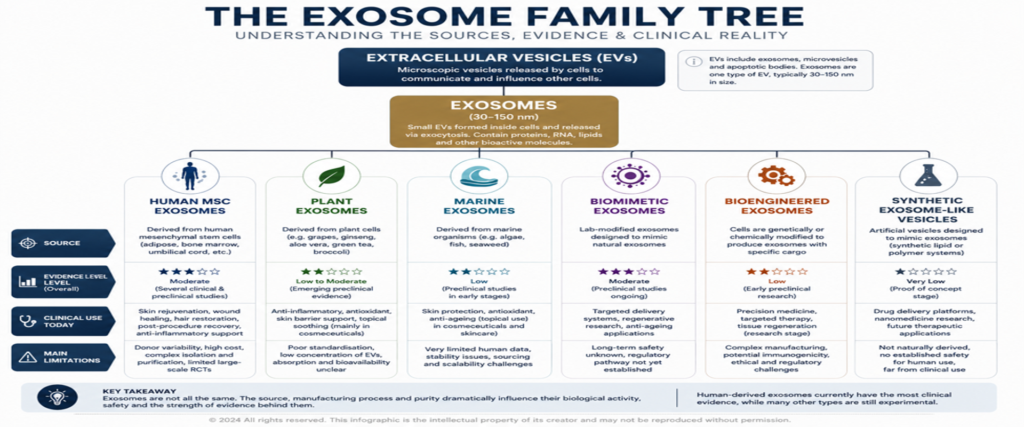
Exosomes are a category.
And even that statement is an oversimplification.
The first thing worth understanding is that many products currently marketed as exosomes would not necessarily be considered equivalent from a scientific standpoint.
This is not a criticism of any particular company.
It’s simply the reality of where the field currently sits.
Imagine walking into a garage and being told you can buy a vehicle.
That information alone tells you almost nothing.
A bicycle, a Ferrari, a tractor and an ambulance are all methods of transport.
They are not the same thing.
The word exosome has gradually become the aesthetic equivalent of the word vehicle.
The label sounds precise.
The reality is much broader
What Is An Exosome?
Cells are constantly communicating with one another.
For years, scientists believed most of this communication happened through hormones, growth factors and direct cellular contact.
Then researchers began paying more attention to tiny membrane-bound particles released by cells.
These particles carry information from one cell to another.
Some contain proteins.
Some contain lipids.
Some contain fragments of RNA.
Some contain combinations of all three.
Exosomes are one type of these tiny particles.
Their job is essentially communication.
They don’t build tissue themselves.
They don’t become skin.
They don’t become collagen.
They deliver messages.
That distinction matters because much of the marketing surrounding exosomes sometimes makes them sound as though they are miniature stem cells.
They are not.
They are better thought of as biological parcels carrying instructions.
The obvious question then becomes:
If exosomes are carrying instructions, whose instructions are they carrying?
This is where things become considerably more complicated.
The MISEV Problem
One of the reasons exosome discussions become confusing is because scientists themselves have spent years trying to standardise the field.
The International Society for Extracellular Vesicles (ISEV) publishes guidance known as MISEV, which stands for Minimal Information for Studies of Extracellular Vesicles.
The fact that such guidelines were needed tells you something important.
Researchers recognised that products being described as exosomes were often being characterised very differently.
Some studies measured particle counts.
Others didn’t.
Some measured surface markers.
Others didn’t.
Some measured purity.
Others didn’t.
Some demonstrated what was actually inside the vesicles.
Others didn’t.
As a result, the scientific community has increasingly moved towards using the broader term extracellular vesicles unless detailed characterisation has been performed.
This may sound like an academic detail.
It isn’t.
Because when patients compare exosomes treatment London clinics offer, there is often an assumption that every exosome product belongs in the same category.
That assumption is rarely true.
Human Mesenchymal Stem Cell-Derived Exosomes
When most clinicians discuss exosomes, this is usually what they are referring to.
These vesicles are derived from mesenchymal stem cells grown under laboratory conditions.
The appeal is obvious.
Mesenchymal stem cells have been studied extensively because of their role in tissue repair, wound healing and inflammation.
If these cells naturally communicate using extracellular vesicles, perhaps some of those benefits could be delivered without using the cells themselves.
That is the theory.
The challenge is consistency.
Not every manufacturer uses the same source cells.
Not every manufacturer uses the same culture conditions.
Not every manufacturer uses the same purification methods.
Two products may both carry the word exosome while being produced very differently.
That makes direct comparison difficult.
Plant-Derived Exosomes
This category has grown rapidly over the last few years.
Many products now utilise vesicles derived from plants, fruits and botanical sources.
The marketing is often attractive.
Natural.
Plant-based.
Vegan.
Sustainable.
Those descriptions may all be true.
The more important question is whether plant-derived vesicles behave in human tissue the way marketing materials sometimes imply.
At present, the evidence remains relatively limited.
The existence of plant vesicles is not controversial.
Their clinical significance in aesthetic medicine is considerably less certain.
That doesn’t mean they don’t work.
It means the confidence of some claims currently exceeds the available evidence.
Fish And Marine-Derived Vesicles
A number of products utilise marine-derived materials, fish extracts or aquatic biological sources.
Again, this is a very different category from human-derived extracellular vesicles.
Yet they are frequently discussed under the same exosome umbrella.
This is one reason I become cautious when people ask whether exosomes work.
The question is too broad.
Which exosomes?
Derived from what
Manufactured how
Characterised to what standard?
Those details matter.
Biomimetic Exosomes
Biomimetic products attempt to imitate naturally occurring extracellular vesicles.
Instead of harvesting vesicles directly from cells, scientists engineer structures designed to resemble them.
The attraction is consistency.
Manufacturing becomes easier.
Scale becomes easier.
Quality control becomes easier.
The downside is that resemblance does not automatically equal equivalence.
A product that looks like an exosome may not necessarily behave like one.
Bioengineered Exosomes
This is where the field starts becoming genuinely fascinating.
Researchers can modify cells to produce vesicles carrying specific cargo.
In theory, this could allow targeted delivery of highly specific messages.
In practice, much of this remains within advanced research rather than routine aesthetic medicine.
When people talk about the future of exosomes, this is often what they mean.
The challenge is that the future and the present are not the same thing.
Many conference presentations discuss where the field may be heading.
Patients deserve to know where the field currently is.
Recombinant And Synthetic Systems
Some products contain recombinant proteins, peptides or synthetic delivery systems designed to reproduce selected aspects of extracellular vesicle function.
These products may eventually prove useful.
The important point is that they should not automatically be treated as interchangeable with naturally derived extracellular vesicles.
Again, the word exosome often creates the illusion that all products belong to the same family.
The reality is considerably messier.
Why This Matters To Patients
One of the biggest mistakes in aesthetics is assuming that treatments sharing a label are therefore comparable.
The reality is that two clinics offering exosomes treatment London may be using products that differ substantially in source material, manufacturing processes, quality control, purity and supporting evidence.
Patients rarely see those differences.
They see the same buzzword.
This is one reason I am cautious about broad claims.
It is also one reason I think patients deserve more transparency than they currently receive.
Because before asking whether exosomes are better than polynucleotides, we first need to establish which exosomes we are talking about.
Only then can we have a meaningful conversation.
What Are Polynucleotides? Why They Are Not Exosomes, Not Fillers, And Not Quite What Most Patients Think They Are
If exosomes are currently the most talked-about treatment in regenerative aesthetics, polynucleotides are probably the most misunderstood.
One of the reasons for this confusion is that polynucleotides don’t fit neatly into an existing category.
They’re not fillers.
They’re not skin boosters in the traditional sense.
They’re not exosomes.
They’re not growth factors.
And they’re certainly not tiny packets of salmon swimming around under the skin, despite what some social media comments might have you believe.
Yet somewhere between the marketing, conference presentations and Instagram reels, many patients have been left with the impression that polynucleotides are capable of rebuilding skin, reversing ageing and somehow persuading tired tissue to behave like it did twenty years ago.
The reality is less dramatic.
And, in my opinion, more interesting.
Where Do Polynucleotides Come From?
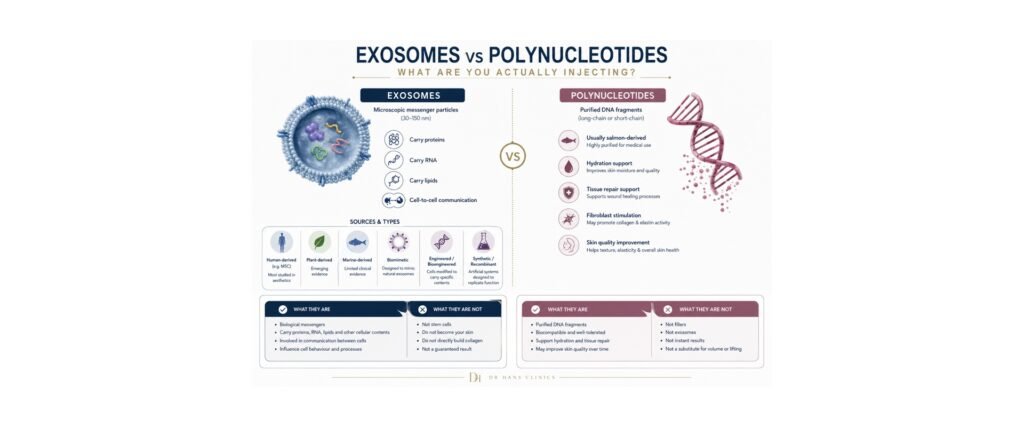
Most commercially available polynucleotide products are derived from highly purified DNA fragments obtained from salmonid species, typically salmon or trout.
That immediately raises eyebrows.
Patients often ask:
“So you’re injecting fish DNA into my face?”
Not exactly.
The important word is purified.
What remains after manufacturing is not a piece of salmon tissue. It is a highly processed and purified collection of DNA fragments designed for medical use.
The rationale behind using salmon-derived material is not random.
Salmon DNA shares structural similarities with human DNA and has historically been used in various medical applications because of its biocompatibility.
The manufacturing process is intended to remove proteins and other components that might trigger unwanted immune responses.
The final product is very different from the source material it originated from.
Polynucleotides And PDRN Are Not The Same Thing
This is another area where confusion is common.
People often use PDRN and polynucleotides
interchangeably.
Strictly speaking, they are related but not identical.
PDRN stands for polydeoxyribonucleotide.
It consists of smaller DNA fragments.
Polynucleotides generally refer to longer-chain DNA fragments.
Both have been studied in wound healing and tissue repair.
Both are often discussed under the same umbrella.
However, they are not necessarily identical products and should not automatically be treated as such.
This becomes important when comparing studies because one paper may be investigating PDRN while another is investigating a polynucleotide preparation.
Unfortunately, those differences are often lost once the treatment reaches social media.
What Are Polynucleotides Actually Supposed To Do?
This is where I think the conversation often goes wrong.
Many clinics jump straight to claims about collagen stimulation.
The truth is that the exact mechanisms are still being investigated.
What we have are proposed explanations supported by varying degrees of evidence.
Several effects have been suggested.
Hydration
One of the most consistent observations is improved skin hydration.
This may sound underwhelming compared with some of the claims made online.
It shouldn’t.
Hydration influences how skin reflects light, how it feels and how healthy it appears.
A surprising number of treatments marketed as regenerative may owe part of their visible effect to improved hydration rather than dramatic structural change.
There is nothing wrong with that.
Patients simply deserve to know the difference.
Fibroblast Activity
Fibroblasts are often described as the workhorses of the dermis.
They are involved in producing collagen, elastin and other components that help maintain skin structure.
Laboratory studies suggest polynucleotides may influence fibroblast behaviour.
This is one reason collagen production is frequently discussed.
The problem is that the phrase “stimulates collagen” has become almost meaningless in aesthetics.
Everything stimulates collagen.
Microneedling stimulates collagen.
Lasers stimulate collagen.
Chemical peels stimulate collagen.
Exercise influences collagen.
The more important question is:
How much?
For how long?
And does it produce a visible difference that matters topatients?
That is a much harder question to answer.
Wound Repair
This is arguably one of the more convincing areas of interest.
Some of the earliest research involving PDRN was not focused on aesthetics at all.
It was focused on wound healing and tissue repair.
This is important because wound repair is a much more measurable endpoint than “looking younger.”
The challenge is that evidence supporting wound repair does not automatically prove dramatic facial rejuvenation.
Those are different claims.
Inflammation And Recovery
Some studies suggest potential effects on inflammatory pathways and tissue recovery.
This is one reason polynucleotides are frequently discussed in:
● Delicate skin
● Periorbital skin
● Post-procedure recovery
● Patients seeking subtle improvements in skin quality
Again, subtle is an important word.
The best polynucleotide results I have seen are often appreciated gradually rather than dramatically.
Which brings us to one of the biggest problems in the entire regenerative aesthetics industry.
The Problem With Expectations
One thing I have noticed repeatedly is that patients often spend a similar amount of money on polynucleotides as they might on treatments capable of producing more visible change.
Then they expect similar outcomes.
That is where disappointment begins.
A patient who undergoes a surgical procedure expects a significant result.
A patient who receives filler often sees an immediate result.
A patient undergoing polynucleotide treatment may be looking for improvements in skin quality that are considerably more subtle.
That does not mean the treatment has failed.
It means the treatment category is different.
Unfortunately, social media rarely does a good job of explaining that distinction.
What Does The Evidence Actually Look Like?
This is where I think clinicians have a responsibility to be honest.
The evidence supporting polynucleotides is encouraging.
That is not the same as saying it is definitive.
The literature contains:
● Case series
● Small clinical studies
● Observational studies
● Industry-supported research
● Consensus papers
● Expert opinion
There are also controlled studies showing improvements in skin quality and elasticity.
However, there are limitations.
One recurring issue is sample size.
Some of the studies frequently referenced within aesthetic education involve very small numbers of participants.
One often-cited publication involved only five patients.
That does not make the study worthless.
It simply means the findings should be interpreted appropriately.
Small studies are useful for generating ideas.
They are not the same thing as large, independent, well-controlled trials.
Another issue is that many studies measure outcomes that matter to researchers more than patients.
Researchers may look at:
● Hydration
● Elasticity
● Histological changes
● Tissue markers
Patients usually care about:
● Looking fresher
● Looking healthier
● Looking less tired
Those goals are related.
They are not identical.
Why We Don’t Automatically Recommend Polynucleotides
This is probably where our approach differs from many clinics.
We offer polynucleotides.
We discuss them.
We use them in selected patients.
But we do not automatically reach for them as a first-line treatment.
There are several reasons.
Firstly, not every patient needs them.
Secondly, not every concern is best treated with them.
Thirdly, I think patients deserve an honest discussion about the strength of the evidence before committing to a treatment plan.
In fact, many of the patients who proceed with polynucleotides at our clinic are people who have had them elsewhere, seen a benefit themselves and understand exactly what they are hoping to achieve.
Those conversations are often much easier because expectations are already grounded in reality.
The treatment is no longer a promise.
It is a personal experience.
And that tends to produce better decisions.
Because one of the lessons aesthetic medicine teaches you repeatedly is that the newest treatment is not automatically the right treatment.
Sometimes it is.
Often it isn’t.
The difficult part is knowing the difference.
What I’ve Learnt After Seeing Patients Ask For Exosomes And Polynucleotides
One of the things that has surprised me most over the last few years is how often patients arrive already convinced they know which treatment they need.
Rarely does somebody walk into clinic asking for a diagnosis.
Instead, they arrive asking for exosomes.
Or polynucleotides.
Or whatever treatment happens to be dominating social media that month.
I understand why.
The internet rewards certainty.
Medicine doesn’t.
The patients who tend to do best are usually not the ones chasing a specific product.
They are the ones focused on solving a problem.
They’re less interested in what is inside the syringe and more interested in understanding why their skin has changed in the first place.
That distinction matters.
Because skin quality, pigmentation, redness, laxity, volume loss and inflammation are all different problems. They may look similar in the mirror, but they do not necessarily respond to the same treatment.
One of the easiest ways to waste money in aesthetics is to become attached to a treatment before understanding the problem you’re trying to solve.
A syringe is not a diagnosis.
A trend is not a treatment plan.
And the newest product is not automatically the best option.
The longer I spend in this field, the more convinced I become that successful outcomes are usually driven by good assessment rather than fashionable products.
Exosomes vs Polynucleotides: Which Actually Has Better Evidence?
This is usually the point where patients expect a simple answer.
Which one is better
Unfortunately, medicine rarely rewards simple answers.
If the question is:
“Which treatment currently has the stronger aesthetic evidence base?”
The answer is probably polynucleotides.
That statement often surprises people because exosomes receive significantly more attention.
Exosomes dominate conference stages.
Exosomes dominate social media.
Exosomes dominate marketing material.
Yet attention and evidence are not the same thing.
One of the recurring problems in aesthetic medicine is that promising science often gets treated as settled science long before the evidence catches up.
Exosomes are a good example.
The laboratory research is genuinely interesting.
Researchers have shown that extracellular vesicles can influence wound healing,
inflammation and communication between cells.
That is where much of the excitement comes from.
The problem is that laboratory findings do not automatically translate into meaningful clinical outcomes.
Many of the claims currently being made about exosomes in aesthetics are based on:
● Laboratory studies
● Animal studies
● Early-stage human studies
● Theoretical mechanisms
● Manufacturer-supported data
That does not mean the treatments are ineffective.
It simply means the certainty of some claims exceeds the certainty of the evidence.
Polynucleotides present a slightly different picture.
The evidence is still far from perfect.
However, there are more human studies examining outcomes relevant to aesthetic practice.
Skin quality.
Hydration.
Elasticity.
Periorbital rejuvenation.
Post-procedure recovery.
Again, this does not mean the debate has been settled.
It means there is currently more clinical data available.
The important distinction is that neither category possesses the sort of evidence that would allow responsible clinicians to make sweeping promises.
And that is exactly where the industry sometimes gets itself into trouble.
The Problem With Aesthetic Evidence
One thing I have learnt over the years is that many patients assume a treatment becomes popular because it has overwhelming evidence behind it.
That would be nice.
Unfortunately, that is not always how the world works.
Aesthetic medicine often adopts treatments long before large-scale evidence exists.
Sometimes those treatments later prove valuable.
Sometimes they don’t
The evidence supporting many regenerative skin treatments suffers from familiar problems:
● Small patient numbers
● Short follow-up periods
● Industry sponsorship
● Lack of placebo controls
● Subjective outcome measures
● Different products being grouped together
This doesn’t mean the research is worthless.
It means it needs to be interpreted carefully.
A positive study is not the same thing as definitive proof.
A negative study is not the same thing as proof of failure.
The truth usually sits somewhere in the middle.
Why Patients Often Feel Underwhelmed
This is probably one of the least discussed topics in regenerative aesthetics.
Not because it isn’t important.
Because it isn’t particularly useful for marketing.
Most dissatisfied patients are not disappointed because something went wrong.
They’re disappointed because expectations and reality never met.
A patient sees phrases like:
● Regenerative
● Tissue repair
● Cellular renewal
● Skin rebuilding
Then spends several hundred or several thousand pounds.
Naturally, they expect something substantial.
The reality is often much more subtle.
Better skin quality.
Slightly improved texture.
Improved hydration.
A healthier appearance.
For the right patient, those outcomes can be worthwhile.
For somebody expecting dramatic transformation, they can feel underwhelming.
Neither perspective is necessarily wrong.
The problem is that the expectation was often unrealistic from the beginning.
The Industry’s Favourite Trick
One thing aesthetic medicine has become exceptionally good at is taking a genuine scientific observation and stretching it far beyond its original meaning.
For example:
A laboratory study shows increased fibroblast activity.
A conference presentation becomes:
“Stimulates collagen.”
A marketing brochure becomes:
“Rebuilds skin.”
A social media post becomes:
“Reverse ageing naturally.”
Each step moves slightly further away from what was originally demonstrated.
Nobody technically lied.
But the final message can end up sounding very different from the original evidence.
This happens with exosomes.
It happens with polynucleotides.
It happens with lasers.
It happens with skin boosters.
It happens with almost every treatment category in aesthetics.
The solution is not cynicism.
The solution is perspective.
Why We Tend To Be More Conservative
One thing patients quickly discover when they come to our clinic is that we are often less enthusiastic than the marketing material.
That is intentional.
I would rather under-promise and over-deliver than the other way around.
One reason we don’t automatically recommend exosomes or polynucleotides as first-line treatments is because there are often more important issues to address first.
A patient with significant sun damage may benefit more from addressing that.
A patient with rosacea may need inflammation controlled.
A patient with volume loss may be looking at the wrong treatment category entirely.
A patient with unrealistic expectations may not be a suitable candidate regardless of the treatment.
The newest treatment is not always the best treatment.
The most talked-about treatment is not always the most appropriate treatment.
And the most expensive treatment is certainly not always the most effective treatment.
Those lessons become obvious once you’ve treated enough patients.
What Patients Should Actually Ask
Rather than asking:
“Are exosomes better than polynucleotides?”
A better question might be:
“What exactly am I trying to improve?”
Because the answer to that question often determines the treatment.
If the primary issue is:
● Skin quality
● Mild crepiness
● Fine texture changes
● Recovery support
The conversation may be very different from somebody concerned about:
● Significant laxity
● Volume loss
● Deep wrinkles
● Structural ageing
Those concerns are not interchangeable.
Neither are the treatments.
And that is why comparing exosomes and polynucleotides as though they are competing products often misses the bigger picture entirely.
The real question is not which one is better.
The real question is whether either of them is the right tool for the job.
What We Do Differently At Dr Hans Clinics
One of the reasons I wanted to write this article is because I think patients deserve a more balanced conversation than they often receive.
Aesthetic medicine has become very good at discussing treatments.
It has become less good at discussing uncertainty.
If you’ve read this far, you’ve probably noticed that I haven’t spent the last few thousand words trying to convince you that exosomes are the future of medicine.
Nor have I tried to convince you that polynucleotides are the answer to every skin concern.
That is deliberate.
Because one of the things experience teaches you is that patients rarely benefit from certainty where certainty doesn’t exist.
The older I get, the less interested I become in making dramatic claims.
The more interested I become in asking sensible questions.
What is bothering the patient?
What are they hoping to achieve?
What evidence supports the treatment?
What evidence doesn’t?
How likely is the treatment to meet their expectations?
And perhaps most importantly:
If this were my own face, would
I spend my own money on it?
That last question tends to cut through a lot of marketing.
Why We Don’t Automatically Recommend Exosomes
This often surprises patients.
They assume that because exosomes are heavily discussed online, they must be part of every treatment plan.
They aren’t.
In fact, we are often more cautious with exosomes than many clinics.
Not because we think they’re useless.
Not because we think they’re dangerous.
But because the evidence is still evolving.
The reality is that exosomes currently sit in an interesting position.
There is enough science to make them interesting.
There isn’t enough evidence to make us blindly confident.
Those are two very different things.
When somebody asks me whether exosomes work, my answer is usually:
“Possibly. In some situations. For some patients. But the confidence of the marketing currently exceeds the confidence of the evidence.”
That’s not a particularly sexy answer.
It’s also the truth.
Why We Don’t Automatically Recommend Polynucleotides
The same principle applies.
We offer polynucleotides.
We use them in selected patients.
But we do not believe every patient walking through the door requires a course of polynucleotides.
In fact, many patients who proceed with polynucleotides at our clinic are individuals who have already experienced the treatment elsewhere and felt it genuinely improved their skin.
Those conversations are often easier because expectations are realistic.
The patient already understands what the treatment can do.
More importantly, they understand what it can’t do.
The challenge with polynucleotides is not usually safety.
The challenge is expectation.
If somebody expects dramatic lifting, dramatic tightening or dramatic rejuvenation, they are likely looking at the wrong treatment category.
If somebody is seeking gradual improvements in skin quality, hydration and overall skin health, the conversation becomes more reasonable.
What I’ve Learnt After Seeing Patients Ask For Exosomes And Polynucleotides
One of the things that has surprised me most over the last few years is how often patients arrive already convinced they know which treatment they need.
Rarely does somebody walk into clinic asking for a diagnosis.
Instead, they arrive asking for exosomes.
Or polynucleotides.
Or whatever treatment happens to be dominating social media that month.
I understand why.
The internet rewards certainty.
Medicine doesn’t.
The patients who tend to do best are usually not the ones chasing a specific product.
They are the ones focused on solving a problem.
They’re less interested in what is inside the syringe and more interested in understanding why their skin has changed in the first place.
That distinction matters.
Because skin quality, pigmentation, redness, laxity, volume loss and inflammation are all different problems. They may look similar in the mirror, but they do not necessarily respond to the same treatment.
One of the easiest ways to waste money in aesthetics is to become attached to a treatment before understanding the problem you’re trying to solve.
A syringe is not a diagnosis.
A trend is not a treatment plan.
And the newest product is not automatically the best option.
The longer I spend in this field, the more convinced I become that successful outcomes are usually driven by good assessment rather than fashionable products.
The Most Expensive Mistake Patients Make
One of the most common mistakes I see is patients chasing treatments rather than chasing outcomes.
Somebody hears about exosomes and decides they need exosomes.
Somebody hears about polynucleotides and decides they need polynucleotides.
Somebody hears about stem cells and decides they need stem cells.
At no point do they stop to ask:
What problem am I actually trying to solve?
That question matters more than the treatment itself.
Because treatments are tools.
Patients don’t need tools.
Patients need solutions.
The treatment only matters if it solves the problem.
Who May Benefit From Exosomes Or Polynucleotides?
This is where the conversation becomes individual.
There is no single profile.
However, these treatments are often considered by patients seeking:
● Improvements in skin quality
● Recovery support following procedures
● Mild textural concerns
● Early signs of ageing
● Delicate under-eye concerns
● Patients wishing to avoid volume-based treatments
Notice what isn’t on that list.
Facelifts.
Major lifting.
Large amounts of volume restoration.
Significant skin laxity.
Those concerns usually require different conversations.
Who Probably Won’t Be Happy?
This is arguably the most important section.
Patients who are likely to be disappointed often include:
● Patients expecting dramatic change
● Patients comparing results to surgery
● Patients comparing results to heavily edited social media photographs
● Patients seeking immediate transformation
● Patients who have not clearly identified what they want to improve
A treatment can perform exactly as expected and still leave a patient disappointed if the expectation was unrealistic to begin with.
That is one reason consultation matters more than most people realise.
The Question Nobody Asks
If there is one thing I would encourage patients to ask, it is this:
“If this treatment didn’t exist, what would you recommend instead?”
It’s a surprisingly revealing question.
Because it forces the conversation away from products and towards problem solving.
A good clinician should be able to explain:
● Why they are recommending a treatment
● Why they are not recommending alternatives
● What evidence supports the decision
● What limitations exist
Without hiding behind marketing language.
Final Thoughts
If you’ve reached this point hoping for a simple winner between exosomes and polynucleotides, you may be disappointed.
That isn’t because the answer is being hidden.
It’s because the question itself is often too simplistic.
At present, polynucleotides probably have a stronger aesthetic evidence base than many commercially available exosome products.
Exosomes remain one of the most interesting areas in aesthetic medicine and may ultimately become extremely important.
But interesting and proven are not the same thing.
The biggest lesson I have learnt over the years is that patients are usually better served by honesty than enthusiasm.
The truth is that neither exosomes nor polynucleotides are miracle treatments.
Neither will stop ageing.
Neither will transform every patient.
Neither deserves the level of certainty that sometimes surrounds them.
That doesn’t mean they don’t have value.
It simply means their value should be judged by evidence rather than excitement.
And until the evidence becomes stronger, that is probably the most sensible place to stand.

Exosomes London, Polynucleotides London, exosome therapy UK, polynucleotide injections London, exosomes vs polynucleotides London, regenerative skin treatment UK, exosomes for skin repair London, polynucleotides for hydration UK, exosomes for collagen stimulation London, polynucleotides for scars London, exosomes vs PRP London, polynucleotides under eye rejuvenation UK, exosomes for anti-aging London, polynucleotides for elasticity UK, regenerative aesthetics London, advanced skin boosters London, exosomes vs fillers UK, polynucleotides vs dermal fillers London, exosomes vs polynucleotides results UK

Dr Hansel Misquitta

Related posts

Written by Dr. Hansel Misquitta. MBBS, MSc Burns Plastic & Reconstructive Surgery, UCL, PGDip Bioethics. Aesthetics Practitioner with background in Plastic Surgery | International Trainer... Continue reading

There is a particular kind of nonsense in aesthetics that keeps coming back dressed as innovation. I am writing this having my own PRP Training... Continue reading

Get Tixel for effective stretch mark treatment in London. Non-laser, thermo-mechanical action remodels skin with minimal downtime. Safe for all skin types. Continue reading

Restore crepey, sun-damaged, and aging skin without fillers or Botox. Discover advanced, natural collagen-boosting treatments like Tixel, Profhilo, or Sunekos for firmer, smoother skin. Continue reading
Add comment