No products in the cart.


Polynucleotides vs PDRN: Ameela, Rejuran, Plinest and the Truth About Salmon DNA Skin Treatments
Written by Dr. Hansel Misquitta. MBBS, MSc Burns Plastic & Reconstructive Surgery, UCL, PGDip Bioethics.
Aesthetics Practitioner with background in Plastic Surgery | International Trainer & KOL | Founder, Dr Hans Clinics London.
Last reviewed: May 2026
Clinic: Dr Hans Clinics, 33 Cavendish Square, London W1G 0PW.
Aesthetics Practitioner with background in Plastic Surgery | International Trainer & KOL | Founder, Dr Hans Clinics London.
Last reviewed: May 2026
Clinic: Dr Hans Clinics, 33 Cavendish Square, London W1G 0PW.
Every few months, aesthetic medicine discovers a new word and immediately behaves like it found the cure for human ageing.
This time, the word is polynucleotides.
Or, if you have been on Instagram for more than seventeen seconds: salmon DNA or Salmon Sperm.
Which sounds scientific, expensive and slightly like something a Bond villain would inject before dinner.
At Dr Hans Clinics in London, we do use polynucleotides. I usually prefer Ameela for injectable polynucleotide treatments. We also use PDRN-containing products, including Lumicen by Toskani and Ameela Exosomes, in selected protocols.
But here is the part people need to hear before they get seduced by a shiny syringe.
I do not usually use polynucleotides as a lonely little miracle treatment.
They can be useful. They can be clever. They can improve the way skin looks and behaves in the right patient.
But they are not filler.
They are not Botox.
They are not a facelift.
They are not magic.
They will not repair your entire face because someone on TikTok said “salmon DNA” with confidence.
A product can be good and still not be the whole plan.
That is where proper clinical judgement comes in.
Why everyone is searching for polynucleotides now
Patients are searching for polynucleotides because the treatment sits in a very current gap.
People want better skin, but they do not always want filler.
They want fresher eyes, but they are nervous about tear trough filler.
They want skin quality, not obvious “work”.
They want something that sounds regenerative, but they also do not want to look like they have joined a cult with a syringe.
That is why search terms around polynucleotides treatment London, Rejuran London, under-eye polynucleotides, PDRN vs polynucleotides and Ameela polynucleotides are showing up across current clinic pages and articles. London clinics are actively targeting treatment-led and brand-led terms such as Rejuran, PDRN, polynucleotides and under-eye polynucleotides.
The problem is that the marketing has run ahead of the explanation.
Patients are hearing:
“Salmon DNA”
“Skin regeneration”
“Cell repair”
“PDRN”
“PN”
“Rejuran”
“Plinest”
“Ameela”
“Exosomes”
And then they are expected to know what all of that means.
Most do not. Fair enough. Half the industry does not explain it properly either.
So let’s clean it up.
What are polynucleotides?
Polynucleotides are chains of nucleotides. Nucleotides are the building blocks of DNA and RNA.
In aesthetic medicine, polynucleotides are usually derived from purified fish DNA, commonly salmon or trout DNA. That is where the “salmon DNA” phrase comes from.
No, this does not mean you leave smelling like a sushi counter.
The material is purified and formulated for skin use. The aim is to support skin quality by improving hydration, tissue repair signalling, fibroblast activity and the extracellular matrix environment.
In plain English: polynucleotides are used to support the skin’s repair environment.
That matters because ageing skin is not just “dry”. It is often thinner, more inflamed, less elastic, slower to repair and less structurally organised.
A simple analogy:
Hyaluronic acid skin boosters water the garden.
Retinoids are the annoying gardener who keeps showing up and actually gets results.
Tixel, microneedling and fractional treatments disturb the soil in a controlled way so repair can begin.
Polynucleotides may help make the soil more biologically supportive.
That is why I do not see them as a magic wand. I see them as one useful part of a proper skin-quality plan.
Very different.
One is medicine. The other is product worship in a white coat.
What is PDRN?
PDRN stands for polydeoxyribonucleotide.
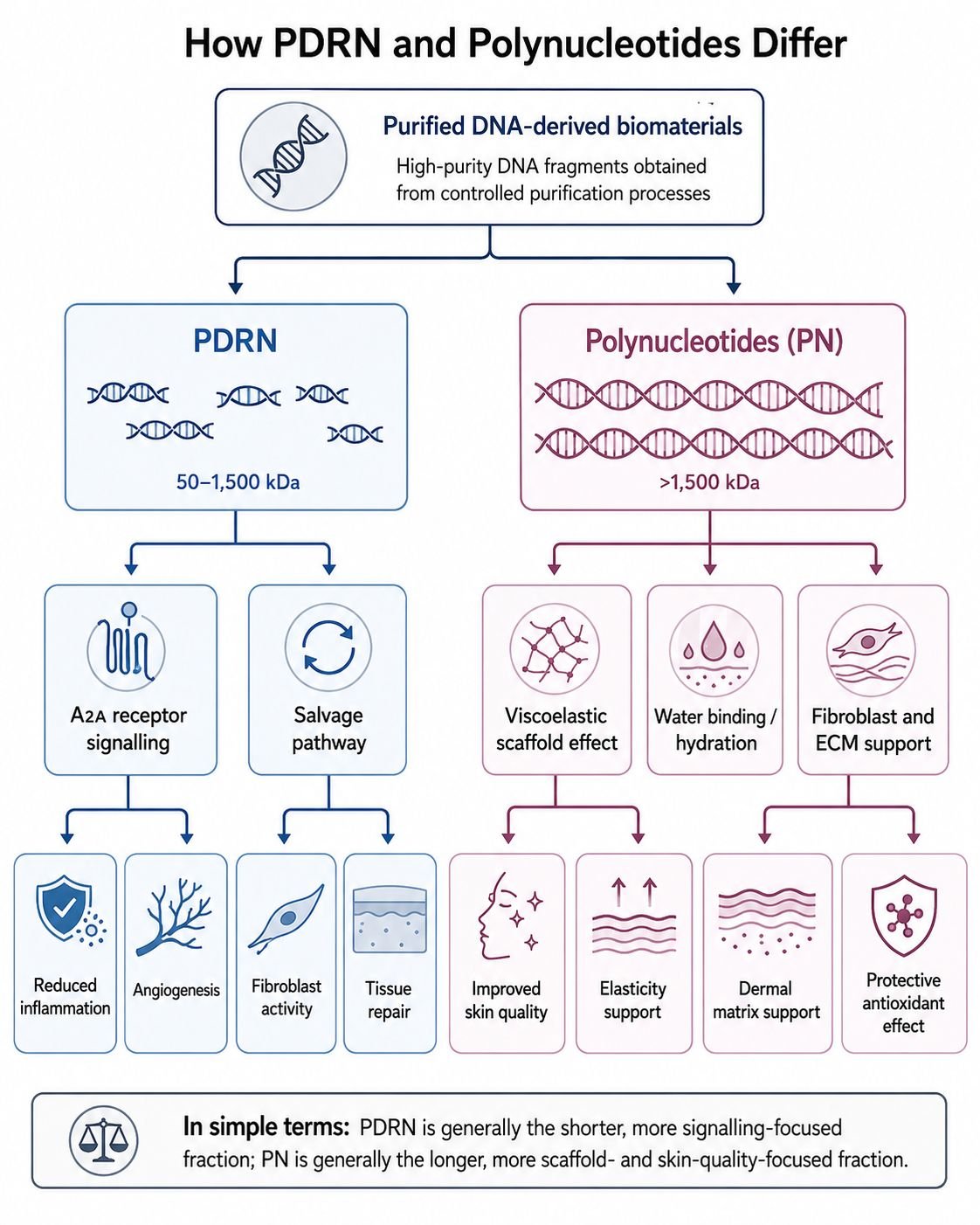
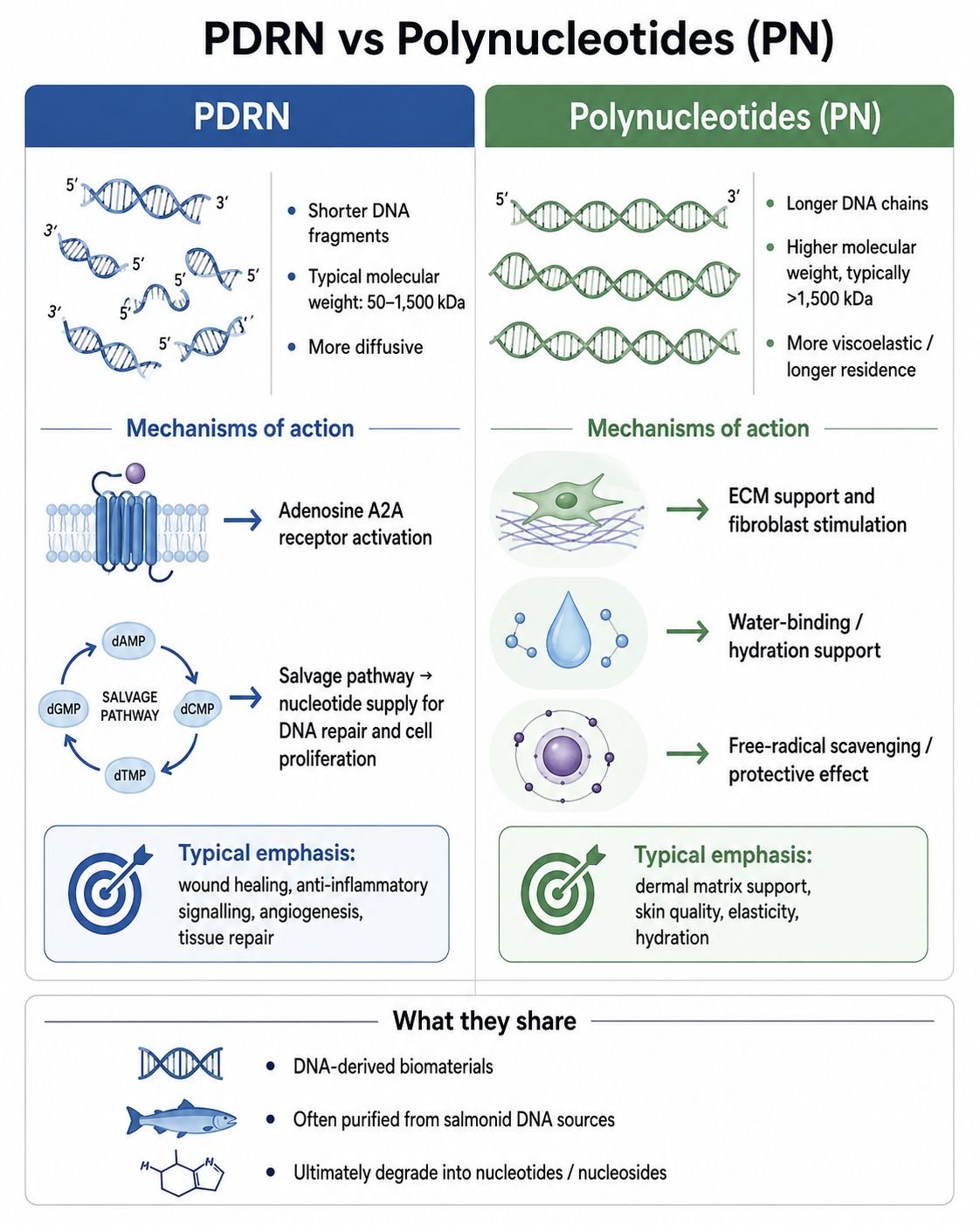
It is also DNA-derived, but it generally refers to shorter DNA fragments than longer-chain polynucleotides.
PDRN has been studied in tissue repair and wound healing. Its proposed mechanisms include adenosine A2A receptor activity, inflammation modulation, angiogenesis and fibroblast behaviour. A 2024 review of polynucleotides in aesthetic medicine discusses both PN and PDRN in the context of skin repair, hydration, elasticity and facial rejuvenation, while also pointing out that more robust evidence is still needed.
Think of it like this.
PDRN is more like small repair signals and spare parts.
Polynucleotides are more like longer-chain support material that may also help hydration and dermal quality.
They are related. They are not identical.
They are cousins, not twins.
And like most cousins at a family wedding, people keep calling them by the wrong name.
PDRN vs polynucleotides: what is the real difference?
The difference is mainly in structure, behaviour and clinical use.
PDRN usually refers to shorter DNA fragments. It is more closely associated with wound healing, inflammation control and repair signalling.
Polynucleotides are longer chains. In aesthetics, they are often positioned around skin quality, hydration, elasticity, texture and gradual dermal improvement.
Some clinics and brands use the terms loosely, which makes it confusing. Current UK clinic and training pages are already creating separate content around “PDRN vs polynucleotides,” which tells us patients and practitioners are actively searching for clarification.
The clean explanation is this:
PDRN may be more about repair signalling.
Polynucleotides may be more about skin quality support.
Both can overlap.
Neither should be sold as a miracle.
That last line is the one marketing departments keep misplacing.
Conveniently.
Why is everyone calling it salmon DNA?
Because “salmon DNA” is catchy.
Also because “purified DNA-derived polynucleotide material used to support dermal quality” does not exactly scream viral content.
Most PN and PDRN products used in aesthetics are derived from fish DNA, usually salmon or trout. The point is not that you are being injected with random fish material. The point is that DNA-derived fragments are purified and processed into formulations that may interact with skin repair pathways.
But the “salmon DNA” phrase has done two things.
It made the treatment memorable.
It also made it sound ridiculous.
Both are true.
My issue is not with the salmon source. My issue is with the way people then leap from “DNA-derived treatment” to “regenerates your skin” as if biology has been bullied into giving a five-star review.
That is not how skin works.
Ameela vs Rejuran vs Plinest: does the brand matter?
Yes, the brand matters.
But not as much as people think.
Patients often ask about Ameela, Rejuran and Plinest because these are the names they see online. Rejuran is one of the better-known PN brands, especially internationally and in Asian aesthetic markets. Plinest has published clinical use around PN-HPT and skin quality. Ameela is increasingly visible in the UK market, and several UK-facing pages mention Ameela alongside other polynucleotide brands.
At Dr Hans Clinics, I usually prefer Ameela.
Not because I think one brand should be worshipped like a skincare deity. That is not medicine. That is brand fandom with a needle.
I prefer Ameela because it fits the way I like to treat skin: gradually, biologically and usually in combination with other treatments when appropriate.
I find it useful when the issue is:
Crepey skin
Fine lines
Thin-looking skin
Under-eye skin quality
Tired or depleted-looking skin
Poor hydration
Mild laxity
Texture changes
Skin that needs repair support after controlled treatment
But here is the key point.
I do not choose Ameela because the patient asks for it.
I choose it if the skin makes sense for it.
There is a difference.
A good product in the wrong patient is still a bad treatment.
Why I usually prefer Ameela at Dr Hans Clinics
Patients often ask whether Ameela, Rejuran or Plinest is the “best” polynucleotide treatment.
That question sounds simple, but it is not.
There is no clean, independent, high-quality head-to-head trial proving that Ameela is universally better than Rejuran or Plinest for every face, every eye and every skin concern. Anyone claiming that is doing what this industry does best: turning uncertainty into confidence and then adding a payment link.
But the products are not identical. And the brand philosophy does matter.
At Dr Hans Clinics, I usually prefer Ameela because it fits my own clinical ethos: precision, transparency, area-specific treatment, evidence-aware claims and combination-led skin planning.
Not “inject the trendy syringe and pray”.
That is not a treatment plan. That is aesthetic karaoke.
1. Ameela is not just one generic polynucleotide syringe
One of the reasons I like Ameela is that the range is designed around different treatment needs rather than pretending one product can do everything.
Ameela Eyes is specifically positioned for the delicate periocular area. Its IFU describes it as a gel based on polymerised polynucleotide 8 mg/ml, with a simple composition: water, sodium DNA and sodium chloride. It is supplied as a 2.5 ml syringe and is intended for skin tone, hydration, elasticity, wrinkles and fine lines around the eye area.
Ameela Rejuvenation is listed as a gel based on polymerised polynucleotide 20 mg/ml, also with a simple composition of water, sodium DNA and sodium chloride. It is positioned for broader rejuvenation work, including skin tone, hydration, elasticity, wrinkles and fine lines.
That matters.
The under-eye skin is not the cheek.
The cheek is not the neck.
The neck is not acne-scarred skin.
A thin, crepey under-eye should not be treated with the same mindset as thicker facial skin.
I like that Ameela gives me a more zone-specific approach. It suits the way I work: anatomy first, tissue quality second, product last.
2. Ameela’s composition is refreshingly simple
Ameela’s IFUs list a very clean composition for the injectable PN gels: water, sodium DNA and sodium chloride.
That does not automatically make it superior to every other brand. Let’s not get drunk on marketing.
But I do like simplicity.
In aesthetic medicine, “more ingredients” does not always mean better. Sometimes it means more opportunities for irritation, more confusion, and more brochure language that sounds like it was written by a skincare toaster.
A clean formulation gives me more confidence when I am treating delicate areas, especially around the eyes, where puffiness, inflammatory reactions and poor product choice can become very visible very quickly.
3. Ameela talks about purification, sterility and sourcing, not just glow
This is a big one.
Ameela’s own educational material states that its polynucleotides undergo sterilisation and purification to remove impurities and contaminants, positioning the product as a pure, sterile solution for skin vitality.
Ameela also states that its wild salmon DNA is sourced as part of an FDA-certified agri-food chain and MSC-certified fisheries, with emphasis on traceability and ethical sourcing.
Now, I am not blindly repeating every brand claim as gospel. Brand material is still brand material.
But I do value transparency around:
Source
Purification
Sterility
Traceability
Composition
Area-specific use
Professional handling
That fits the Dr Hans Clinics ethos.
If something is being injected into the skin, I want less mystery, not more. The face is not a lucky dip.
4. Ameela fits combination treatments better than isolated product worship
Ameela’s wider platform includes polynucleotides, PDRN, exosomes, growth factors, peptides and collagen-based product concepts across its ecosystem. Its exosome IFU describes Ameela Exosomes as a solution based on high and low molecular weight hyaluronic acid combined with polynucleotides, exosomes, growth factors and peptides.
This matters because I do not usually use PN or PDRN as isolated “one syringe fixes all” treatments.
At Dr Hans Clinics, Ameela may sit within a wider plan involving:
Microneedling
Dermastamping
Tixel
Fractional treatments
PRP or PRF
Skin boosters
Barrier repair
Medical skincare
Post-procedure recovery support
That is where Ameela makes sense for me.
Not as a standalone miracle.
Not as a salmon-DNA sermon.
Not as “regeneration” shouted into a ring light.
It is a tool inside a plan.
5. Ameela’s ethos is closer to how I want aesthetic medicine to move
Ameela’s own brand philosophy talks about science-driven innovation, elegant simplicity, purposeful design, integrity, precision and transparency.
That language matters to me because it is closer to the direction aesthetic medicine should be moving in.
Less noise.
Less “miracle treatment”.
Less fake regeneration language.
Less product hysteria.
More clarity.
More patient selection.
More evidence-aware explanation.
More honesty about what a product can and cannot do.
That is why Ameela fits my clinic voice.
Not because I think it is a sacred object.
Because the framework around it, the simple formulation, the area-specific range and the transparency around sourcing and purification sit better with the way I practise.
6. How I compare Ameela with Rejuran and Plinest
Rejuran is well known, especially in Asian aesthetic markets. It has strong brand recognition around salmon DNA, PDRN/PN and “healer” style treatments. I respect the category, but strong brand recognition is not the same thing as the right treatment for every patient.
Plinest has strong polynucleotide heritage through Mastelli’s PN-HPT technology. A PubMed-indexed exploratory study on PN-HPT reported that it may be a useful option for improving dermal texture and quality, but the authors also called for larger, well-designed trials.
Ameela is the one I usually reach for because it fits my own clinical setup better: specific options for eyes and broader rejuvenation, simple IFU-listed composition, transparency around purification and sourcing, and compatibility with combination-led skin treatment.
So no, I am not saying Ameela is “the best” bh lazy, unsupported flattery I am saying this:
Ameela is my preferred polynucleotide option because it fits my treatment philosophy better. Does it mean the others are bad, well as I mentioned there are no head to head trials and studies comparing them together.
The philosophy is simple:
Do not sell the trend.
Diagnose the skin.
Choose the product that makes sense.
Combine only when there is a reason.
Do not call everything regeneration just because the syringe has a fancy label.
Very inconvenient for marketing. Very useful for patients.
Are polynucleotides good for under-eyes?
They can be.
The under-eye area is one of the most common reasons patients search for polynucleotides. London clinic pages are specifically targeting under-eye polynucleotides and under-eye skin-quality concerns, which reflects real search intent.
I like polynucleotides for selected under-eye patients because they may help with:
Crepey texture
Thin-looking skin
Fine lines
Poor skin quality
Tired-looking under-eyes
Mild laxity
But they do not fix every under-eye problem.
They will not reliably correct:
Deep tear trough hollows
Significant midface volume loss
Fat prolapse
True eye bags
Fluid retention
Genetic pigmentation
Heavy vascular shadowing
Severe laxity
This is where people get disappointed.
They book “under-eye polynucleotides” when what they actually have is a structural hollow, a fat pad issue or pigmentation.
Then everyone pretends it is “still settling”.
No, darling. Sometimes it was never the right treatment.
The under-eye area is not where we do fairy tales. Fairy tales around the eyes become swelling, disappointment and awkward follow-ups.
Can PDRN be used with microneedling, dermastamping or Tixel?
Yes, and this is where PDRN often makes more biological sense.
At Dr Hans Clinics, we use PDRN-containing products such as Lumicen by Toskani and Ameela Exosomes in selected protocols. I usually prefer using these with treatments that create controlled channels or controlled injury, such as microneedling, dermastamping, Tixel or fractional treatments.
Why?
Because the skin barrier exists.
It is not decorative. It is not a suggestion. It is not a polite curtain that opens because a serum cost more than your weekly shop.
Topical PDRN has limitations because larger or fragile molecules may struggle to penetrate intact skin meaningfully. Recent mainstream beauty coverage has also highlighted the issue of PDRN’s topical penetration, fragility and formulation challenges, which supports why clinical delivery logic matters.
Microneedling and microneedle delivery systems are studied because they create microchannels that can support delivery of selected topical agents through the skin barrier. Fractional laser-assisted delivery is also studied for similar reasons: controlled channels can improve topical delivery, although outcomes depend on device, settings, molecule size, vehicle and protocol.
This is why I do not usually slap a PDRN serum on intact skin and start speaking like it has entered the dermis by divine intervention.
Use the right active.
Use the right delivery method.
Use the right timing.
Use the right patient.
Otherwise, you are just making the epidermis watch an expensive product sit on top of it.
Why I do not usually use polynucleotides alone
Because most skin problems are not caused by one missing ingredient.
This is where aesthetic marketing becomes painfully lazy.
Dull skin does not automatically mean “needs polynucleotides”.
Crepey skin does not automatically mean “needs Ameela”.
Under-eye ageing does not automatically mean “needs salmon DNA”.
Acne scarring does not automatically mean “needs regeneration”.
Skin quality is affected by:
Collagen loss
Elastin damage
UV exposure
Barrier dysfunction
Inflammation
Pigmentation
Vascular changes
Hormones
Medication
Sleep
Stress
Weight change
Menopause
Smoking
Over-exfoliation
Poor skincare
A skincare routine that looks like someone robbed Space NK during a nervous breakdown
So I do not look at a face and think: “One syringe will solve this.”
That is not cynicism. That is experience.
At Dr Hans Clinics, polynucleotides may sit inside a wider plan involving Tixel, microneedling, dermastamping, PRP, PRF, skin boosters, peels, medical skincare or barrier repair.
Not all at once.
Your face is not a buffet plate at a chaotic wedding.
The skill is knowing what to do first, what to combine, what to avoid and when to say no.
That is the part you cannot buy in a box.
What can polynucleotides realistically improve?
Polynucleotides may help with:
Fine lines
Crepey skin
Thin-looking skin
Poor hydration
Dullness
Mild laxity
Texture changes
Under-eye skin quality
Tired-looking skin
General skin resilience
Post-treatment skin support in selected cases
The key phrase is skin quality.
Not lifting.
Not restructuring.
Not replacing tissue.
Not removing fat pads.
Not reversing ageing like a Netflix fantasy series.
Polynucleotides may improve the quality of the fabric.
They do not rebuild the whole outfit.
What polynucleotides will not fix
This matters more than the benefits, because this is where patients waste money.
Polynucleotides will not reliably fix:
Deep acne scars as a standalone treatment
Significant sagging
Severe under-eye bags
Deep tear trough hollows
Major pigmentation
Heavy jowling
Loose neck skin
Deep folds caused by volume loss
Poor skincare habits
Unrealistic expectations
The belief that one trendy treatment can repair fifteen years of sun damage and stress
They may support skin quality, but they are not a substitute for the correct treatment.
If someone has deep acne scarring, they may need acne scar treatments such as Tixel, microneedling, subcision, TCA CROSS, fractional treatments or combination work.
If someone has severe laxity, they may need a surgical opinion.
If someone has pigmentation, the plan may need topical pigment control, peels, laser or energy-based devices depending on skin type.
The point is simple.
Treat the diagnosis, not the trend.
What does the evidence say?
The evidence is promising, but it is not perfect.
A 2024 review of polynucleotides in aesthetic medicine reported that PN and PDRN are being used for skin rejuvenation, texture, wrinkles, hydration and facial appearance. It also makes clear that study quality, protocols and product types vary, and that more robust evidence is needed.
There is also growing interest in PDRN for skin-related applications including wrinkles, dryness, hyperpigmentation, hair loss and barrier dysfunction, but much of this remains an evolving dermatology and aesthetics field rather than a settled clinical certainty.
Polynucleotide-based treatments are also being studied for scars and burns, including Rejuran-based PN therapy, again showing that this is an active area of research rather than pure beauty fluff.
So here is my honest reading:
Polynucleotides are not nonsense.
PDRN is not nonsense.
The biology is interesting.
Some clinical results are encouraging.
But the evidence is still developing.
The hype is ahead of the data.
That is usually where trouble starts in aesthetic medicine.
The phrase “promising evidence” should not be translated into “guaranteed regeneration”.
That is not science. That is sales with a lab coat.
My honest view as a skin-focused aesthetic practitioner
I like polynucleotides.
I like Ameela.
I like PDRN in the right context.
I like using Lumicen by Toskani and Ameela Exosomes when the treatment plan makes sense, especially with microneedling, dermastamping, Tixel or fractional treatments.
But I do not like the way this category is often marketed.
I do not like calling everything regeneration.
I do not like pretending PDRN serums can bypass biology.
I do not like selling under-eye polynucleotides to patients who actually need structural correction.
I do not like giving one product the job of an entire treatment plan.
At Dr Hans Clinics, the first question is not:
“Do you want polynucleotides?”
The first question is:
“What is actually wrong with the skin?”
Is it thin?
Is it inflamed?
Is it crepey?
Is it scarred?
Is it pigmented?
Is it dehydrated?
Is it structurally hollow?
Is the barrier damaged?
Is the patient chasing a trend rather than a diagnosis?
That is where real treatment starts.
Not with a syringe.
With assessment.
Very unsexy. Very effective.
Final thoughts
Polynucleotides are one of the more interesting treatments in skin-quality aesthetics.
They may support hydration, texture, fine lines, elasticity and repair-related pathways. They may be useful around the under-eyes, face, neck and selected areas of poor skin quality. PDRN-containing products may also have a role when used intelligently with delivery-based treatments such as microneedling, dermastamping, Tixel or fractional protocols.
But they are not magic.
They are not a facelift.
They are not filler.
They are not surgery.
They are not a personality transplant for tired skin.
At Dr Hans Clinics, I use them when they make clinical and biological sense.
Not because “salmon DNA” sounds expensive.
Not because everyone is currently shouting about them online.
And definitely not because the aesthetic industry has decided every face now needs a regenerative origin story.
Sometimes the best treatment is Ameela.
Sometimes it is PDRN with microneedling.
Sometimes it is Tixel.
Sometimes it is skincare.
Sometimes it is doing absolutely nothing until the skin barrier stops behaving like it has been through a divorce.
That is the difference between selling a treatment and treating a patient.
And in this industry, that difference matters more than ever.
Evidence and Expectations
Polynucleotides and PDRN have promising evidence for improving skin quality, hydration, texture, elasticity and repair-related pathways. However, the evidence is still developing. Many aesthetic studies are small, product-specific or use different protocols, which makes direct comparison difficult. Results are usually gradual rather than dramatic.
At Dr Hans Clinics, we use Ameela polynucleotides and PDRN-containing products such as Lumicen by Toskani and Ameela Exosomes as part of a wider skin-quality plan, not as standalone miracle treatments.
Why trust this article?
This article has been written from clinical experience at Dr Hans Clinics in London and is based on current evidence around polynucleotides, PDRN, skin-quality injectables and delivery-based treatments.
It does not treat polynucleotides as a miracle treatment. It explains where products such as Ameela, Rejuran, Plinest, Lumicen by Toskani and Ameela Exosomes may fit, where evidence is still developing, and where patients should be cautious.
Because good aesthetics is not about chasing the newest syringe. It is about knowing when that syringe is useful, and when it is just expensive theatre.
FAQ'S
Are PDRN and polynucleotides the same?
No. They are related, but not exactly the same. PDRN usually refers to shorter DNA fragments, while polynucleotides are longer nucleotide chains. Both are DNA-derived and may support repair-related pathways, but their behaviour and clinical use can differ.
Is Ameela better than Rejuran?
Not automatically. Rejuran is well known, especially internationally. Ameela is the product I usually prefer at Dr Hans Clinics because it fits my combination-led skin-quality approach. The better question is not “which brand is best?” It is “which product makes sense for this skin?”
Is Plinest better than Ameela?
Plinest has published use in polynucleotide skin treatments, and Ameela is also used for skin-quality protocols. The right choice depends on the area, skin quality, treatment goal, tolerance and the clinician’s technique.
What is salmon DNA treatment?
“Salmon DNA treatment” is the popular phrase used for polynucleotide or PDRN-based aesthetic treatments derived from purified fish DNA. It sounds dramatic, but the actual treatment is about using purified DNA fragments to support skin-quality and repair-related pathways.
Are polynucleotides good for under-eyes?
They can be useful for crepey, thin or tired-looking under-eye skin. They are not a complete solution for deep hollows, eye bags, fat prolapse or genetic pigmentation.
Do polynucleotides help dark circles?
Sometimes, but only if the dark circles are partly due to thin skin or poor skin quality. If the cause is pigmentation, vascular shadowing, anatomy or volume loss, polynucleotides may only give limited improvement.
Do polynucleotides replace tear trough filler?
No. Polynucleotides improve skin quality. Tear trough filler addresses selected volume or contour issues. They are different treatments for different problems.
Can PDRN be used after microneedling?
Yes, in selected patients. Microneedling creates microchannels, which may support delivery of certain topical actives. This is why PDRN-type products may make more sense after microneedling than simply applied onto intact skin.
Can PDRN be used after Tixel?
Yes, where appropriate. Tixel creates controlled thermal micro-injury and may support certain delivery-style protocols. Suitability depends on the settings, skin type, healing response and product used.
How many polynucleotide sessions do I need?
Most patients need a course of 2 to 4 sessions, depending on the area treated, skin quality and whether the treatment is combined with other procedures.
Are polynucleotides worth it?
They can be worth it for the right patient with the right indication, especially for skin quality, crepiness and gradual improvement. They are not worth it if the real issue is structural volume loss, heavy laxity or a problem that needs a different treatment.
What is the downside of polynucleotides?
The main downsides are cost, the need for multiple sessions, temporary swelling or bruising, variable results and the risk of being sold the treatment when it is not actually the right option.
Clinical note from Dr Hans
I prefer Ameela because it fits my skin-quality approach, but I do not use it automatically. If a patient’s concern is structural hollowing, significant laxity, fat prolapse, deep scarring or pigmentation, polynucleotides alone are unlikely to be enough.
That is the difference between treating skin and simply selling whatever is trending. I do not always reach out for Polynucleotides and Exosomes in my clinic and often see them as adjuncts or skin boosters with short term effects.
About the author
Dr Hansel Misquitta (Dr Hans) is an aesthetic practitioner with a background in plastic surgery and advanced skin-focused aesthetic medicine. She is the founder of Dr Hans Clinics in London, where her work focuses on evidence-led, natural-looking treatments for skin quality, ageing, restorative aesthetics, skin and hair treatments.
Her approach is deliberately cautious: treat the diagnosis, not the trend. Dr Hans does not use polynucleotides as a standalone miracle treatment. Instead, she uses products such as Ameela, Lumicen by Toskani and Ameela Exosomes as part of a wider skin-quality plan when clinically appropriate, often alongside treatments such as microneedling, dermastamping, Tixel, PRP, PRF or prescription skincare.
Clinic: Dr Hans Clinics, 33 Cavendish Square, London W1G 0PW
Clinical focus: Skin quality, aesthetic medicine, aesthetics, hair restoration and non-surgical rejuvenation
Content reviewed: May 2026
Confused by polynucleotides, PDRN, Ameela, Rejuran, Plinest or the salmon DNA circus?
Book a skin consultation at Dr Hans Clinics in London. We will assess your skin properly, explain what is realistic, and tell you if polynucleotides are not the right treatment.
No fairy dust. No trend-chasing. No salmon sermon.
Just a clinical plan that makes sense.
polynucleotides pdrn, polynucleotide treatment, salmon dna treatment, skin rejuvenation, collagen booster, wrinkle reduction, aesthetic clinic london, pdrn injections, ameela polynucleotides, rejuran healer, collagen induction, non surgical facial rejuvenation, skin texture improvement, fibroblast stimulation, aesthetic medicine, best polynucleotide treatment, injectable skin booster, skin tightening treatment, facial collagen booster, skin regeneration treatment, polynucleotides facial london, pdrn facial london, rejuran facial london, ameela facial london, polynucleotides for wrinkles, polynucleotides for fine lines, polynucleotides for sagging skin, polynucleotides for hydration, polynucleotides for elasticity, polynucleotides for scars, polynucleotides for pigmentation, polynucleotides for under eye rejuvenation, polynucleotides collagen stimulation, polynucleotides fibroblast therapy, polynucleotides anti ageing london, polynucleotides skin booster uk, polynucleotides rejuvenation london, polynucleotides advanced facial london, dr hans clinics polynucleotides, london aesthetics polynucleotides, polynucleotides cosmetic treatment london, polynucleotides skin clinic london, polynucleotides collagen boosting treatment, polynucleotides minimally invasive facial london

Dr Hansel Misquitta


Related posts
If you’ve spent any time around aesthetic medicine over the last few years, you’ve probably noticed that one word has quietly taken over almost every... Continue reading

There is a particular kind of nonsense in aesthetics that keeps coming back dressed as innovation. I am writing this having my own PRP Training... Continue reading

Get Tixel for effective stretch mark treatment in London. Non-laser, thermo-mechanical action remodels skin with minimal downtime. Safe for all skin types. Continue reading

Restore crepey, sun-damaged, and aging skin without fillers or Botox. Discover advanced, natural collagen-boosting treatments like Tixel, Profhilo, or Sunekos for firmer, smoother skin. Continue reading
Add comment